






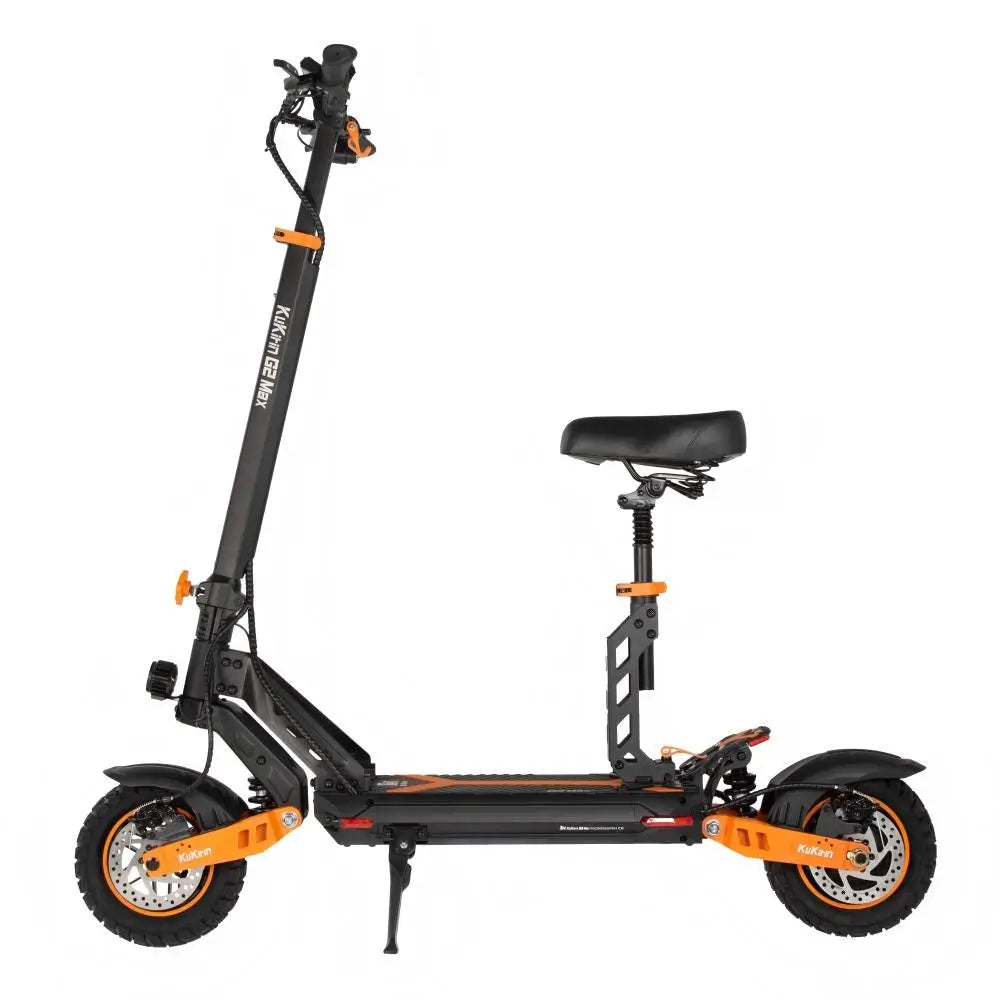




G2 Master Extreme Test: 120kg Load on a 28° Slope

Every electric scooter has a spec sheet. It lists the max load (120kg), the max climbing angle (28°), and the motor power (1000W × 2). But spec sheets are tested under ideal conditions. What happens when you combine all those maximums at once?
If you are a heavier rider, or if you frequently carry cargo, you need to know if those numbers are real or just marketing. Will the motors stall? Will the controller overheat? Will the tires lose traction on the incline?
We decided to find out. We took the KuKirin G2 Master, loaded it to its absolute limit, and pointed it up a brutal 28° slope in 30°C summer heat.
Here is what happened.

The Test Conditions: Pushing the Absolute Limits
To make this test relevant to the heaviest riders and the steepest commutes, we didn’t hold back.
-
Total Payload: Exactly 120kg (rider weight + weighted backpack).
-
The Slope: A continuous 28° incline (roughly a 53% gradient). This is significantly steeper than almost any paved public road in Europe.
-
Ambient Temperature: 30°C (86°F). Summer heat adds thermal stress to the motors and controllers.
-
Terrain: Dry, rough asphalt. (Testing on wet or loose surfaces at this angle would be dangerous).

Power and Torque: Does It Actually Climb?
The G2 Master is equipped with dual 1000W motors (1200W peak each) and a 52V electrical system.
The Start: This is the moment of truth. On a 28° slope with 120kg of weight, a single-motor scooter would immediately stall or burn out the controller. The G2 Master, however, pulls away smoothly. The dual-drive system distributes the load across both wheels, preventing the rear tire from spinning out or losing traction.
Mid-Climb Acceleration: Even halfway up the slope, the throttle remains responsive. If you slow down to 10km/h to navigate a bump, the scooter can accelerate back up to 15-20km/h. The torque (26 N·m) is sufficient to maintain momentum without feeling like the motors are straining.
Top Speed on the Slope: With 120kg on a 28° incline, the scooter tops out at a steady 15-18km/h. You won’t be breaking speed records, but you are moving continuously without stalling.
Thermal Stress: What Happens to the Motors?
Climbing generates heat. Climbing a steep grade with maximum weight generates a lot of heat.
After 5 minutes of continuous climbing, we stopped to check the motor temperatures.
-
Motor Hubs: The rear and front motor housings were hot to the touch (estimated 65-70°C). This is expected under extreme load.
-
Controller: The controller housing under the deck was warm but not dangerously hot.
-
Thermal Protection: The scooter did not trigger thermal protection or cut power.
The Catch: The motors rely on passive cooling (airflow). When climbing slowly at 15km/h, airflow is minimal. If we had continued climbing for another 10 minutes at this weight, the BMS would likely have intervened to protect the motors.
Recommendation: If you weigh near the limit and face long, steep climbs, pull over for 5 minutes every 15 minutes to let the motors cool.

Battery Drain: The Brutal Reality
Gravity is the enemy of range. On flat ground, the G2 Master’s 20.8Ah battery can deliver up to 70km of range.
On a continuous 28° slope, the energy consumption is staggering. You are fighting both wind resistance and gravity.
-
Estimated consumption: Climbing a steep grade at max load drains the battery roughly 2.5 to 3 times faster than flat riding.
-
Real-world range: Under these extreme conditions, the 70km range drops to approximately 25 to 30km.
The Lesson: If your commute involves long, steep hills and you are a heavy rider, plan your routes carefully. You cannot rely on the flat-ground range estimates.
Braking on the Descent: The Real Danger
Going up is hard. Coming down is dangerous.
When you descend a 28° slope with 120kg, gravity pulls you hard. The G2 Master features front and rear disc brakes plus an electronic brake.
The Test: We rode the brakes down the slope, maintaining a safe speed of about 15km/h.
-
Brake Performance: The disc brakes provided strong, confident stopping power. There was no brake fade during the descent.
-
Electronic Brake: The motor cut-off engaged immediately when the levers were pulled.
-
Heat: The brake rotors were extremely hot at the bottom. They will burn you if you touch them immediately after a descent.
Crucial Tip: Never ride the brakes continuously down a long hill. Alternately apply the front and rear brakes to let them cool, or let the scooter roll slightly faster to get more airflow through the brake calipers.

The Final Verdict: Is It Worth It?
The KuKirin G2 Master passed the extreme test.
-
Power: The dual motors provide enough torque to haul 120kg up a 28° slope without stalling.
-
Traction: The dual-drive system keeps the tires planted on the pavement.
-
Safety: The braking system manages the heavy descent without overheating.
But there are limits. This test puts maximum stress on every component. For daily riding, this is the absolute limit of what the scooter is designed to do. The motors will run hot, and the battery will drain quickly.
If you weigh 120kg and face these kinds of hills daily, the G2 Master will do the job—but you must respect the thermal limits and plan your charging accordingly.
For riders who want maximum climbing capability with a higher performance buffer, the KuKirin G4 Ultra electric scooter offers dual 1200W motors and a 60V platform, delivering even more torque for extreme hills.
Frequently Asked Questions
Can the G2 Master really carry 120kg?
Yes. The frame, deck, and suspension are rated for 120kg. However, at this weight, acceleration is slower, braking distances are longer, and battery range is reduced.
Will the G2 Master climb a 28° slope with a heavy rider?
Yes. During our test, it successfully climbed a 28° slope with a 120kg payload at a steady 15-18km/h. The dual motors prevent stalling.
Does climbing steep hills damage the motor?
Not if you manage the heat. Continuous climbing at maximum load generates significant heat. If the motor gets too hot, the BMS will limit power to prevent damage. Stop periodically to let the motors cool.
How much range do I lose when climbing hills?
On a steep incline (like a 20-28° slope), expect to lose 50-60% of your flat-ground range. A 70km scooter might only get 25-30km in mountainous terrain.
Is it safe to ride down a steep hill on a scooter?
Yes, if you manage your brakes. Do not hold the brakes continuously, as they will overheat and fail. Use intermittent braking and let the electronic brake assist you.
Which is better for heavy riders, G2 Master or G4 Ultra?
The G4 Ultra offers a 60V platform and more torque, providing a larger performance buffer for heavy riders on steep hills. However, the G2 Master is a highly capable alternative at a lower price point.
Ride Heavy, Ride Prepared
The KuKirin G2 Master proves that a dual-motor scooter can handle the maximum load on severe terrain. But riding at the limit requires common sense.
Check your tire pressure. Watch your battery. Let the motors cool. If you respect the physics, the G2 Master will haul you up any hill.
Apply discount code NEW20 at checkout to save on your next KuKirin:
-
KuKirin G2 — €519
-
KuKirin G2 Pro — €499
-
KuKirin G2 Pro (VMP) — €519
-
KuKirin G2 Pro (ABE) — €519
-
KuKirin G2 VMP — €519
-
KuKirin G2 Max — €699
-
KuKirin G2 Ultra — €739
-
KuKirin G2 Master — €969
-
KuKirin M4 Max — €469
-
KuKirin G4 — €969
-
KuKirin G4 Ultra — €989
-
KuKirin T4 — €989
-
KuKirin X1 — €1,269
Prices reflect discount code NEW20 applied.